
SLATE
By Jordan Weissmann
May 1, 2014

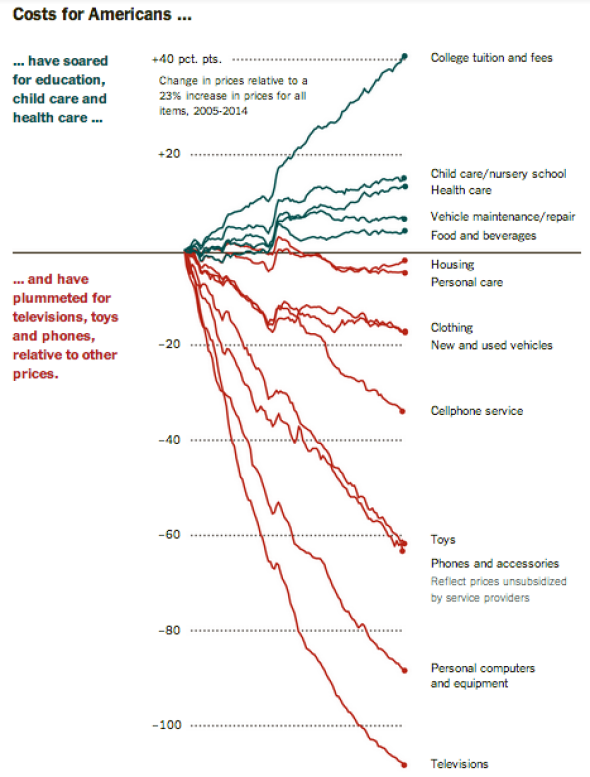
How punishing is poverty in 2014? That depends. When it comes to consumer goods, low-income families might have it better than ever. The poor can now buy cheap cellphones and televisions that would have seemed like fantastical luxuries to yesteryear’s rich. Microwaves and air conditioners are standard. Food is relatively inexpensive, as is clothing.
At the same time, some essentials are receding from the poor’s reach. Education, health care, and child care, I probably don’t need to tell you, are all becoming more expensive by the year.
This is the tension at the core of modern impoverishment, which Annie Lowrey takes on in the New York Times today. The wonders of globalization, modern manufacturing, and ruthless Walmart-style supply-chain management have made the stuff we buy to fill our homes and time much cheaper, and as a result the poor now enjoy a level of material well-being that would have seemed unimaginable decades ago. The safety net is also infinitely more generous compared with the early 1960s, before Lyndon Johnson launched his war on poverty. Yet, because the prices of key services are spiraling out of control, the poor’s lot is still rather hopeless. The NYTcaptures it in this very, very long graph. (More commentary to follow.)
To enlarge NYT graph below, click here.
 ArchitectGuy on Israel