
THE ECONOMIST
May 3, 2014
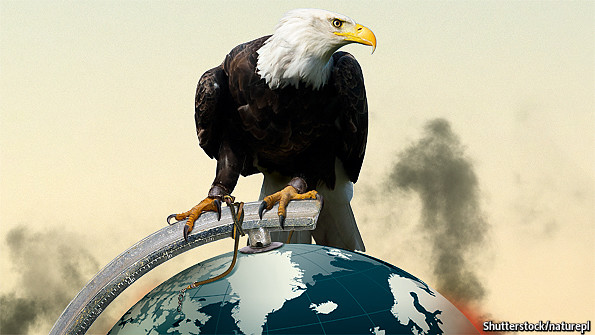
“WHY is it that everybody is so eager to use military force?” America’s cerebral president betrayed a rare flash of frustration on April 28th when dealing with a question in Asia about his country’s “weakness”. Barack Obama said his administration was making steady, if unspectacular, progress. By blundering into wars, his critics would only harm America.
Mr Obama was channelling the mood of his people, worn out by the blood and treasure squandered in Iraq and Afghanistan. A survey last autumn by the Pew Research Centre suggests that 52% want the United States to “mind its own business internationally”, the highest figure in five decades of polling. But when America’s president speaks of due caution, the world hears reluctance—especially when it comes to the most basic issue for any superpower, its willingness to fight.
For America’s most exposed allies that is now in doubt (see article). For decades, America’s security guarantee used to underpin Japan’s foreign policy; now, on his Asian tour, Mr Obama has had to reassure Japan that it can count on America if China seizes the disputed Senkaku islands (which China calls the Diaoyus). After his tepid backing for intervention in Libya and Mali and his Syrian climbdown, Israel, Saudi Arabia and a string of Gulf emirates wonder whether America will police the Middle East. As Vladimir Putin, Russia’s president, disrupts Ukraine, eastern Europeans fret that they are next.
…..Yet Mr Obama has still made a difficult situation worse in two ways. First, he has broken the cardinal rule of superpower deterrence: you must keep your word. In Syria he drew “a red line”: he would punish Bashar Assad if he used chemical weapons. The Syrian dictator did, and Mr Obama did nothing. In response to Russia’s aggression, he threatened fierce sanctions, only to unveil underwhelming ones. He had his reasons: Britain let him down on Syria, Europe needs Russian gas, Congress is nervous. But the cumulative message is weakness.
Second, Mr Obama has been an inattentive friend. He has put his faith in diplomatic coalitions of willing, like-minded democracies to police the international system. That makes sense, but he has failed to build the coalitions. And using diplomacy to deal with the awkward squad, such as Iran and Russia, leads to concessions that worry America’s allies. Credibility is about reassurance as well as the use of force.
….But the West will also end up paying dearly for the fraying of the global order….America is preoccupied with avoiding foreign entanglements. Mr Obama began his presidency with the world wondering how to tame America. Both he and his country need to realise that the question has changed.
 ArchitectGuy on Israel