
BREAKING DEFENSE
by James Kitfield
August 7, 2014
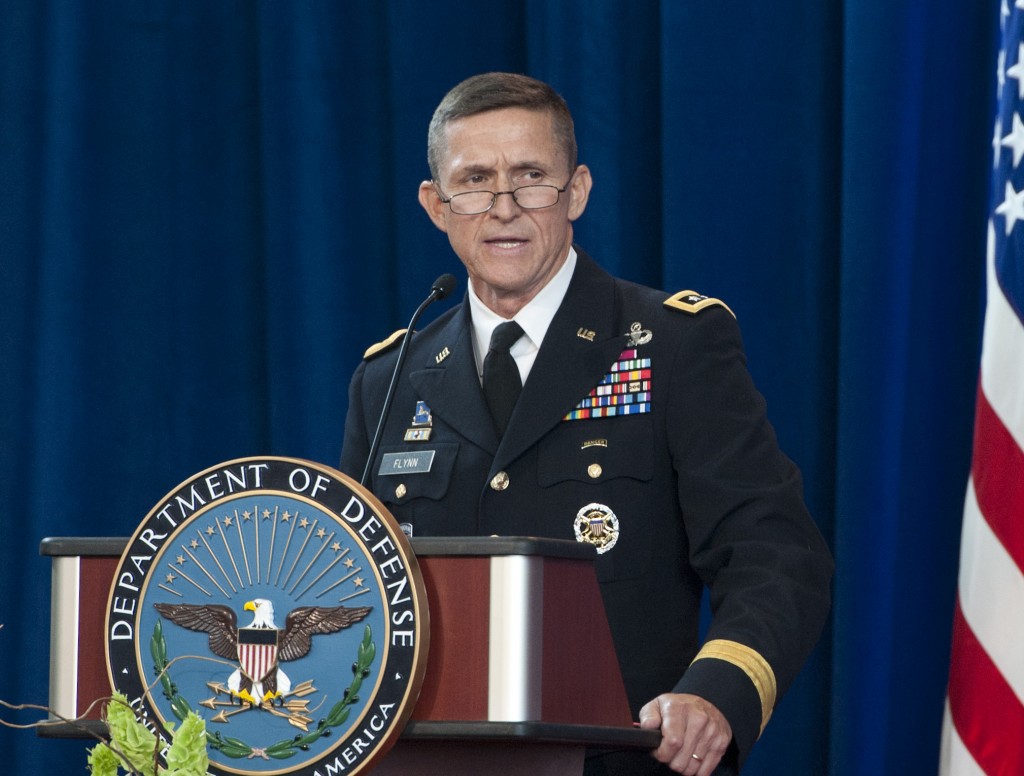
In this exclusive exit interview with Breaking Defense contributor James Kitfield, the outgoing chief of the Defense Intelligence Agency, Lt. Gen. Michael Flynn, talks about metastasizing Islamic terrorism, his struggles to reform intelligence-gathering, and the risk of lurching from crisis to crisis in an Internet-accelerated world. – the editors.
“Disruptive.” That’s how Michael Flynn’s enemies reportedly described him during his time as director of the Defense Intelligence Agency, a tenure that ends tomorrow – a year early – when the three-star general retires after 33 years in the US Army. Was Flynn forced out? The Pentagon said his departure had been “planned for some time” when it made the announcement in April. But Flynn had challenged the Obama administration narrative that al-Qaeda’s brand of nihilistic extremism had died with Osama bin Laden in 2011. He had bruised egos at the DIA trying to transform the 17,000-person bureaucracy into a more agile and forward-deployed intel operation, one shaped by the lessons he had learned as intelligence chief for Joint Special Operations Command in Iraq and Afghanistan, working for the ill-fated iconoclast Gen. Stanley McChrystal. As early as 2010, Flynn made waves with a report, Fixing Intel, that said US intelligence could not answer “fundamental questions” in Afghanistan.
James Kitfield: DIA is tracking global crises from Ukraine to the Mideast to North Koreaand the Western Pacific. Have you ever seen so many crises occurring simultaneously?
Flynn: No. I come into this office every morning, and other than a short jog to clear my head, I spend two to three hours reading intelligence reports. I will frankly tell you that what I see each day is the most uncertain, chaotic and confused international environment that I’ve witnessed in my entire career. There were probably more dangerous times such as when the Nazis and [Japanese] Imperialists were trying to dominate the world, but we’re in another very dangerous era. We rightfully talk about the last decade being the longest war in American history, for instance, but when we pull combat troops out of Afghanistan at the end of this year, it’s not going to feel like that war is over. To me, it feels like we’ll be facing a familiar threat and heightened uncertainty for a long time yet.
JK: Why?
Flynn: I think we’re in a period of prolonged societal conflict that is pretty unprecedented. In the Middle East, we’re starting to see issues arise over boundaries that were drawn back in the post-colonial era following World War I. In some regions, we’re seeing the failure of the nation-state, and to some degree the disintegration of the [Westphalian] system of nation-states: Look at Libya, or Mali, or Nigeria. Because of a youth bulge, Nigeria will be the third most populated country on the planet in ten years, and [the Al Qaeda-linked terrorist group] Boko Haram is active in half of that country. Then look at what’s happening in Iraq and Syria. What I see is a strategic landscape and boundaries on the global map changing right before our eyes. That change is being accelerated by the explosion of social media. And we in the intelligence community are trying to understand it all……..
 ArchitectGuy on Israel