
THE NEW REPUBLIC
by Eric Trager
May 19, 2014
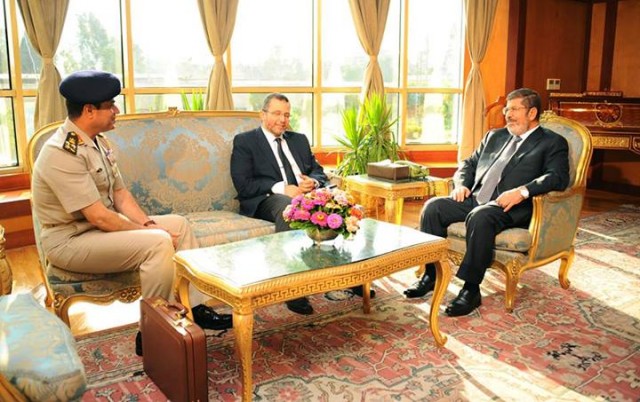
Since the uprising-cum-coup that ousted Egyptian President Mohamed Morsi last summer, Washington has encouraged the Muslim Brotherhood and the military-backed government to pursue “reconciliation.” Nearly a year later, however, neither side appears interested in conceding anything to the other. The military fears that a remobilized Brotherhood would quickly win power and seek vengeance. And despite an unrelenting crackdown that has claimed over 2,500 lives and jailed over 16,000 Egyptians, the Brotherhood’s demands haven’t softened: Morsi must return, at least temporarily, and those who removed him—particularly General Abdel Fatah al-Sisi, who is widely expected to win the presidential election next week—must be executed. Until then, Muslim Brothers vow to continue resisting the coup, because—they insist—they are winning. In other words, forget “reconciliation”: The existential struggle that has defined Egyptian politics since Morsi’s removal will likely continue, and worsen.
To be sure, there has been ongoing communication—sometimes direct, but mostly indirect—between the military-backed government and the Brotherhood since July. But the two sides’ demands remain mutually exclusive. While the Brotherhood often downplays its demand that Morsi return to power, it still emphasizes the restoration of “legitimacy,” which effectively means the same thing. “The return of Morsi, continuing his rule, is not what we want,” Mohamed Touson, a former Brotherhood parliamentarian and a member of Morsi’s legal team, told me, before adding: “Morsi should come back just to take the decision for new elections and leave office.”
The Brotherhood is also demanding “transitional justice”—a phrase that Brotherhood leaders deliberately borrowed from post-apartheid South Africa, but then stripped of its conciliatory significance. According to one Brotherhood leader, the Brotherhood wants to appoint an “independent committee” to investigate security forces’ deadly crackdown on the Brotherhood’s anti-coup protests, “and the results will be compulsory for everyone, with the killings … considered murders”—meaning that Sisi and many of his colleagues would be convicted of mass murder and put to death. Younger Muslim Brothers are particularly emphatic on this point. “He should be executed when the coup falls,” said a Brotherhood student at Cairo University. Of course, the military won’t accept a set of demands that entail the generals’ deaths.
 ArchitectGuy on Israel